Static diagrams drift
Visual models explain intent, but too often sit apart from requirements, APIs, payloads, tests, controls and governance evidence.
 Modelattice
Blueprint → contract → evidence
Modelattice treats the visual model as a typed source, specifications as inputs, connectors as graph relationships and generated outputs as evidence. The Attice story becomes a practical delivery protocol: blueprint in, proof out.
Product-agnostic by design. Built for complex, regulated and API-enabled change.
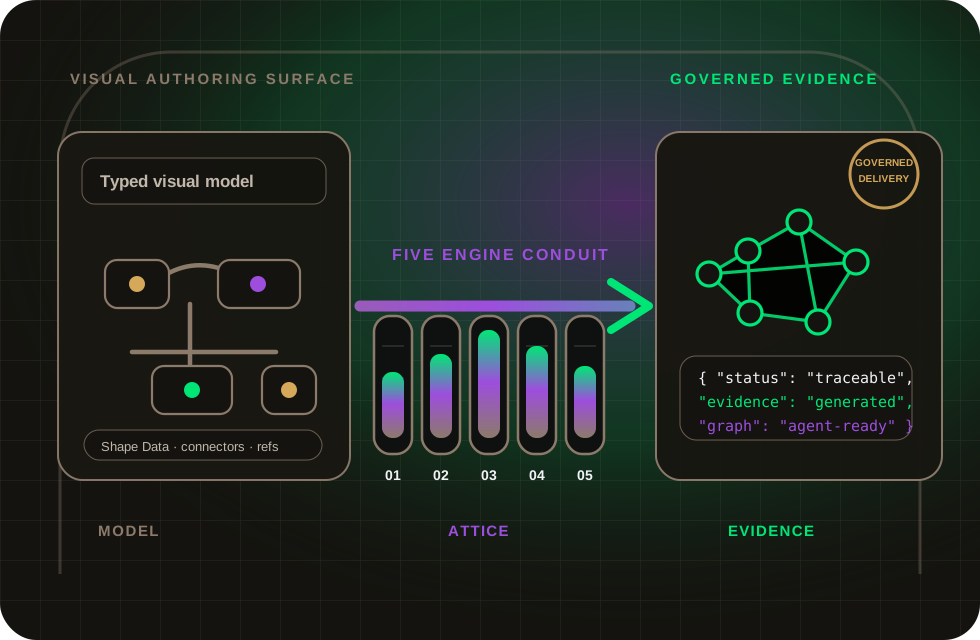
Model + Attice
Model is the controlled blueprint: the human-readable structure of the design. Attice is used as a Roman-inspired delivery metaphor: the disciplined craft of bringing complex potential safely into the world.
Author the visible structure: shapes, stages, decisions, APIs, controls and source references.
Bring the structure into governed delivery: canonical data, graph relationships, traceability, evidence and replay.
Design does not drift into disconnected artefacts. The model becomes the evidence contract.
The problem
Visual models explain intent, but too often sit apart from requirements, APIs, payloads, tests, controls and governance evidence.
Specifications define capability, but the link to process steps, UI actions, data fields and operating controls is often manual or incomplete.
AI agents need typed nodes, relationships, source validation and governance rules. Unstructured documents are not enough for dependable traversal.
The method
Modelattice captures solution design as a structured model: typed elements, typed relationships, API-derived references, graph-ready exports, evidence controls and generated delivery artefacts.
Core rule
The visible model is the human interface. The metadata is the semantic layer. The connectors are the relationship graph. The generated artefacts are controlled views.
Five-engine methodology
Human-readable solution models built with typed shapes, containers, layers, connectors and model metadata.
OpenAPI, schemas, events and source specifications become controlled technical reference inputs.
Graph exports and traversal rules let AI agents analyse impact, gaps, coverage, dependencies and source evidence.
Readiness gates, source validation, decisions, risks, controls and baseline evidence are generated from the model.
Walkthroughs, process replay, exception routes and scenario modelling become generated views of the model.
Generated outputs
Requirements, traceability, stage summaries, process catalogues, decisions, RAID logs and readiness reports.
API catalogues, payload dictionaries, UI-to-payload mappings, fit-gap, error handling and sensitive data registers.
Test scenarios, acceptance criteria, coverage matrices, synthetic data needs and audit evidence packs.
Node files, relationship files, graph schema, traversal policy, starter queries and AI-agent review packs.
Target capability models, RFI/RFP questions, vendor scoring, demo scripts and proof-of-concept evidence.
Scenario routes, exception walkthroughs, user journeys and Champion/Challenger modelling evidence.
Why now
As AI agents become part of delivery work, organisations need models that are readable by people and traversable by machines. Modelattice is designed to make solution design explicit, source-aware and evidence-ready.
Foundation-stage methodology
Modelattice is currently in foundation-stage development. The first public materials focus on the methodology, artefact catalogue, API/specification modelling, graph export and AI-agent governance.
No analytics, tracking or form collection are enabled in this static page.